

How To Prevent Nox From Downloading Random Games
Transport Emulator console commands
Each running virtual device provides a console that lets you lot query and command the emulated device surroundings. For case, yous can utilise the console to manage port redirection, network characteristics, and telephony events while your app is running on the emulator.
The following commands crave that you already have an emulator running. For more data virtually running an emulator, see Run Apps on the Android Emulator and Start the Emulator from the Command Line.
Start and stop a console session
To admission the panel and enter commands, from a terminal window, utilise telnet to connect to the panel port and provide your authentication token. Each fourth dimension the panel displays OK, it'due south set to accept commands. It doesn't accept a typical prompt.
To connect to the console of a running virtual device:
- Open a terminal window and enter the post-obit command:
- Later the console displays
OK, enter theauth auth_tokencontrol. - Later you're connected to the console, enter console commands.
- To leave the panel session, enter
quitorleave.
telnet localhost console-port
The emulator window title lists the console port number. For example, the window title for an emulator using console port 5554 could be Nexus_5X_API_23:5554. Likewise, the adb devices control prints a list of running virtual devices and their console port numbers. For more information, run into Querying for Emulator/Device Instances.
Note: The emulator listens for connections on ports 5554 to 5585 and accepts connections from localhost only.
Before you tin enter panel commands, the emulator console requires authentication. auth_token must match the contents of the .emulator_console_auth_token file in your home directory.
If that file doesn't be, the telnet localhost console-port command creates the file, which contains a randomly generated authentication token. To disable authentication, delete the token from the .emulator_console_auth_token file or create an empty file if it doesn't exist.
Enter assist, help command , or assistance-verbose to see a list of console commands and acquire about specific commands.
Here'south an instance session:
$ telnet localhost 5554 Trying ::ane... telnet: connect to accost ::1: Connection refused Trying 127.0.0.1... Continued to localhost. Escape character is '^]'. Android Panel: Authentication required Android Panel: blazon 'auth <auth_token>' to authenticate Android Console: you can find your <auth_token> in '/Users/me/.emulator_console_auth_token' OK auth 123456789ABCdefZ Android Console: type 'help' for a list of commands OK help-verbose Android panel command aid: help|h|? print a listing of commands assist-verbose print a list of commands with descriptions ping check if the emulator is live automation manage emulator automation issue simulate hardware events geo Geo-location commands gsm GSM related commands cdma CDMA related commands crash crash the emulator instance crash-on-exit simulate crash on exit for the emulator case kill kill the emulator example restart restart the emulator instance network manage network settings power power related commands quit|go out quit control session redir manage port redirections sms SMS related commands avd control virtual device execution qemu QEMU-specific commands sensor manage emulator sensors physics manage physical model finger manage emulator finger impress debug control the emulator debug output tags rotate rotate the screen clockwise by 90 degrees screenrecord Records the emulator'due south display fold fold the device unfold unfold the device multidisplay configure the multi-display try 'assistance <control>' for command-specific aid OK get out Connexion airtight by foreign host.
Emulator command reference
The following tabular array describes the emulator panel commands with their parameters and values.
Table one. Emulator console commands
| General Commands | Description |
|---|---|
avd {stop|start|status|proper noun} | Query, control, and manage the virtual device, as follows:
|
avd snapshot {list|salvage name|load proper noun|delete name} | Save and restore the device land in snapshots, as follows:
The post-obit instance saves a snapshot with the name avd snapshot save firstactivitysnapshot |
fold | Fold the device to display its smaller screen configuration (if the device is foldable and currently unfolded). |
unfold | Unfold the device to display its larger screen configuration (if the device is foldable and currently folded). |
kill | Stop the virtual device. |
ping | Cheque whether the virtual device is running. |
rotate | Rotate the AVD counterclockwise in 45 caste increments. |
| Crash the emulator | Clarification |
crash | Crash the emulator during app execution. |
crash-on-exit | Crash the emulator when the app exits. |
| Debug tags | Description |
debug tags ... | Enable or disable debug messages from specific parts of the emulator. The tags parameter must be a value from the list of debug tags that appears when you lot execute The post-obit example enables the debug radio |
| Port redirection | Clarification |
redir listing | Listing the current port redirection. |
redir add protocol:host-port:guest-port | Add a new port redirection, every bit follows:
|
redir del protocol:host-port | Delete a port redirection.
|
| Geographic location | Description |
| Set the geographic location reported to the apps running within an emulator by sending a GPS fix to the emulator. You tin result the | |
geo fix longitude latitude [distance] [satellites] [velocity] | Transport a unproblematic GPS fix to the emulator. Specify longitude and latitude in decimal degrees. Use a number from 1 to 12 to specify the number of satellites to use to determine the position, and specify distance in meters and velocity in knots. |
geo nmea judgement | Send an NMEA 0183 judgement to the emulated device, as if it were sent from an emulated GPS modem. Kickoff sentence with '$GP'. Only '$GPGGA' and '$GPRCM' sentences are currently supported. The following instance is a GPGGA (Global Positioning Organization Fix Data) sentence that gets the time, position, and fix data for a GPS receiver: geo nmea $GPGGA ,hhmmss.ss,llll.ll,a,yyyyy.yy,a,x,twenty,x.x,x.x,M,x.x,K,x.x,xxxx |
| Fake hardware events | Description |
event types | List all fake event types. For events that have codes, the number of codes is listed in parens on the correct. event types event <type> can be an integer or one of the following aliases: EV_SYN EV_KEY (405 lawmaking aliases) EV_REL (ii code aliases) EV_ABS (27 code aliases) EV_MSC EV_SW (4 code aliases) EV_LED EV_SND EV_REP EV_FF EV_PWR EV_FF_STATUS EV_MAX OK |
issue ship types [types ...] | Send one or more than fake event types. |
event codes blazon | List the event codes for the specified fake event blazon. |
event transport type[:code]:[value] [...] | Send one or more than simulated events with optional codes and code values. To notice exactly which consequence to send, you tin use the These are the events generated when y'all press the power button: adb shell getevent -lt /dev/input/event12: EV_KEY KEY_POWER Downward /dev/input/event12: EV_SYN SYN_REPORT 00000000 /dev/input/event12: EV_KEY KEY_POWER UP /dev/input/event12: EV_SYN SYN_REPORT 00000000In this item case, we only needed to ship the ii EV_KEY events, keydown, and a keyup event to simulate a long printing of the power button: event transport EV_KEY:KEY_POWER:0 OK event ship EV_KEY:KEY_POWER:1 OK |
event text bulletin | Send a string of characters that simulate keypresses. The message must be a UTF-viii cord. Unicode posts are reverse-mapped co-ordinate to the current device keyboard, and unsupported characters are discarded silently. |
| Control the power state reported by the emulator to apps | Description |
power display | Brandish battery and charger state. |
power ac {on|off} | Set AC charging state to on or off. |
power status {unknown|charging|discharging|non-charging|full} | Change battery status as specified. |
power present {true|false} | Fix battery presence country. |
power health {unknown|good|overheat|dead|overvoltage|failure} | Set battery health state. |
power capacity percent | Set remaining battery capacity land equally a per centum from 0 to 100. |
| Network connection status | Clarification |
network condition | Check the network status and current delay and speed characteristics. |
network delay latency | Alter the emulated network latency. The emulator lets you simulate various network latency levels, and then that you can test your app in an surround more typical of the actual weather condition in which it will run. Y'all can prepare a latency level or range at emulator startup, or you lot tin can utilize the console to change the latency while the app is running in the emulator. To set latency at emulator startup, employ the emulator -netdelay gprs emulator -netdelay 40,100 To make changes to network delay while the emulator is running, connect to the panel and utilise the network filibuster gprs network filibuster 40 100 Network latency format: The format of network latency is one of the following (numbers are milliseconds):
|
network speed speed | The emulator lets yous simulate various network transfer rates. Yous can set up a transfer charge per unit or range at emulator startup, or you tin can use the console to change the charge per unit, while the app is running in the emulator. To set the network speed at emulator startup, apply the emulator -netspeed gsm @Pixel_API_26 emulator -netspeed 14.4,80 @Pixel_API_26 To make changes to network speed while the emulator is running, connect to the console and utilize the network speed 14.4 80 Network speed format: The format of network
|
network capture {showtime|end} file | Ship packets to a file. The following list describes the parameters and parameter values:
|
| Telephony emulation | Description |
| The Android emulator includes its own GSM and CDMA emulated modems that let you simulate telephony functions in the emulator. For example, with GSM y'all can simulate inbound phone calls and found and cease data connections. With CDMA you provide a subscription source and the preferred roaming listing. The Android system handles imitation calls exactly as it would actual calls. The emulator does not support telephone call audio. | |
gsm {phone call|accept|abolish|decorated} phonenumber | The gsm parameters are the post-obit:
|
gsm {data|vocalisation} state | The information country command changes the state of the GPRS data connection, and the information voice state changes the state of the GPRS vocalization connection, every bit follows:
|
gsm concord | Modify the land of a call to hold. Yous can alter a telephone call state to hold only when its current land is agile or waiting. |
gsm list | List all inbound and outbound calls and their states. |
gsm status | Report the current GSM voice/data land. Values are those described for the vocalism and data commands. |
gsm signal {rssi|ber} | Modify the reported bespeak strength (rssi) and bit fault charge per unit (ber) on the next 15 seconds of update. The following list describes the parameters and their values:
|
gsm signal-profile num | Set the signal strength profile. Enter a number from 0 through 4. |
cdma ssource source | source : Set the current CDMA subscription source where source is a network-based allowlist that contains the CDMA carrier's subscribers and their values, every bit follows:
|
cdma prl_version version | Dump the current preferred roaming listing (PRL) version. The version number is for the PRL database that contains information used during the organisation selection and acquisition process. |
| Manage Sensors on the emulator | Description |
These commands relate to which sensors are available in the AVD. Besides using the sensor command, you lot can run across and adjust the settings in the emulator in the Virtual sensors screen in the Accelerometer and Additional sensors tabs. For more information, see Working with the extended controls, settings, and help. | |
sensor status | List all sensors and their status. The following is case output for the sensor status control: |
sensor get sensor-name | Get the settings for sensor-name . The following example gets the value for the acceleration sensor: sensor get acceleration acceleration = ii.23517e-07:9.77631:0.812348 The |
sensor ready sensor-proper noun value-x:value-y:value-z | Fix the values for sensor-name . The following example sets the dispatch sensor to the post-obit x, y, and z values separated by colons. For more than information, see Working with the extended controls, settings, and help. sensor set acceleration 2.23517e-07:9.77631:0.812348 |
| SMS emulation | Description |
sms transport sender-phone-number textmessage | Generate an emulated incoming SMS. The following listing describes the parameter and their values:
The following instance sends the message "hello there" to the 4085555555 phone number. sms transport 4085555555 hullo there The console forwards the SMS bulletin to the Android framework, which passes it to an app on the emulator that handles SMS, such every bit the Messages app. If you lot pass 10 numbers, the app formats it as a phone number. Longer or shorter numeric strings display the fashion you sent them. |
| Fingerprint simulation | Description |
finger impact fingerprint-id | Simulate a finger touching the sensor. |
finger remove | Simulate finger removal. For instructions about how to use these commands, see Fingerprint simulation and validation. |
Fingerprint simulation and validation
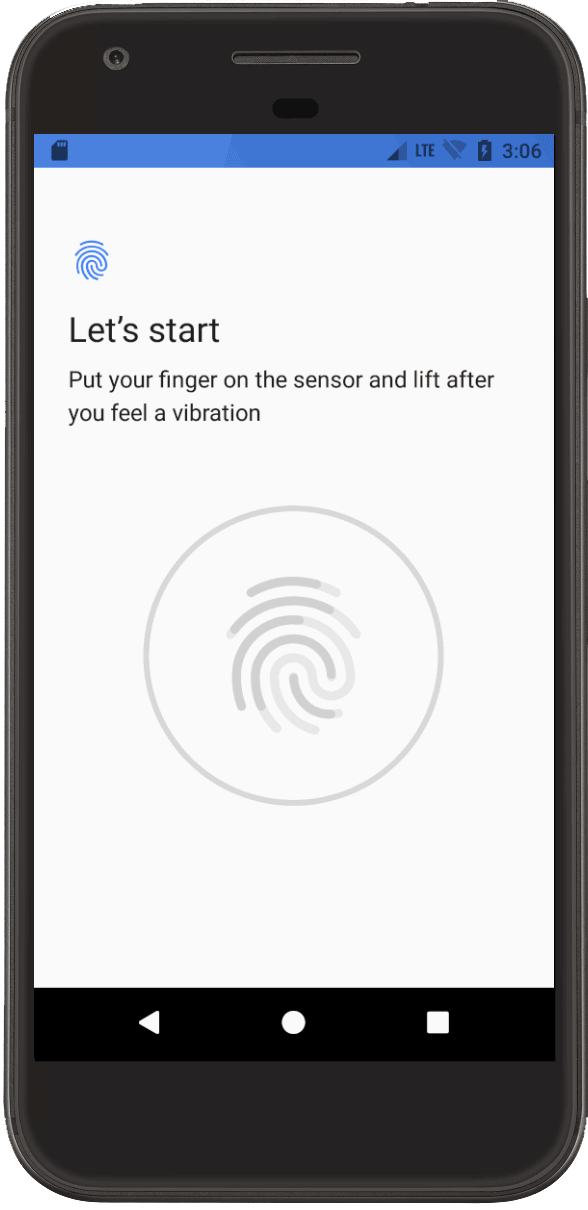
Figure one. Fingerprint authentication screen.
Use the finger command to simulate and validate fingerprint hallmark for your app. You demand SDK Tools 24.iii or higher, and Android 6.0 (API level 23) or higher.
To simulate and validate fingerprint hallmark, follow these steps:
- If you don't still accept a fingerprint ID, enroll a new fingerprint in the emulator by selecting Settings > Security > Fingerprint and following the enrollment instructions.
- Ready upwards your app to accept fingerprint hallmark. Afterward you perform this setup, your device displays the fingerprint hallmark screen.
- While your app displays the fingerprint authentication screen, become to the console and enter the
finger touchcommand and the fingerprint ID you created. This simulates a finger touch. - Then, enter the
finger removecontrol to simulate finger removal.Your app should answer as if a user touched and so removed their finger from the fingerprint sensor.
Content and lawmaking samples on this page are subject to the licenses described in the Content License. Java and OpenJDK are trademarks or registered trademarks of Oracle and/or its affiliates.
Terminal updated 2021-09-15 UTC.

How To Prevent Nox From Downloading Random Games,
Source: https://developer.android.com/studio/run/emulator-console
Posted by: skidmorelaidearks.blogspot.com
0 Response to "How To Prevent Nox From Downloading Random Games"
Post a Comment